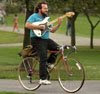
I've been playing public places several times a week the past few weeks, including a metaphysical bookstore, a coffee shop, and a bar, besides also playing for other groups of people at various locations.
Tonight from five to eight p.m. I was at Charley's BBQ again for the third week in a row (last week I played Red Baron and Prayer). My first turn at Charley's tonight I played Hot Young Blonde, Running Out of Time and the Beatles song Help! After everyone else got their turn at the open microphone night, I got another turn just before they shut down. I played Oh! Jennifer! and What Can I Say? All these songs except for the Beatles song Help! are from my new (but as yet unrecorded) album When you ride over sharps, you get flats!
Then I went to a cocktail lounge downtown and got a contact number for the man who arranges entertainment there. I will call him tomorrow. Then I went to the Jersey Lilly, a bar that also has open jam sessions on Tuesday nights starting at nine p.m. The house band played a set, then I had a turn. I played my original song Red Baron, Help! by the Beatles, and Behind Blue Eyes by The Who (actually what I play is closer to Pete Townshend's acoustic version).
Showing posts with label Help. Show all posts
Showing posts with label Help. Show all posts
Tuesday, August 16, 2011

Tuesday, August 2, 2011
Charley's BBQ open mike night
I played two songs earlier tonight at Charley's BBQ on West Harvard Avenue. The first was one of mine, Early Morning Hours. Then I played the Beatles song Help! Both were well-received. A little later I rode and played in the parking lot next door while some people watched from the windows.
Last month I noticed a shimmy in the front wheel when I was going down hills, even though the tires were inflated properly. So yesterday I dropped the "Minstrel Cycle" off at the Local Bike Shop to have them true both wheels. It turns out the front axle had a little play and the rear wheel was way out of shape, so it's a good thing I had this done. I picked up the bicycle from the bike shop at 4 p.m. and the music started at the BBQ place at 5. I had to wait a while for my turn to play.
Last month I noticed a shimmy in the front wheel when I was going down hills, even though the tires were inflated properly. So yesterday I dropped the "Minstrel Cycle" off at the Local Bike Shop to have them true both wheels. It turns out the front axle had a little play and the rear wheel was way out of shape, so it's a good thing I had this done. I picked up the bicycle from the bike shop at 4 p.m. and the music started at the BBQ place at 5. I had to wait a while for my turn to play.
Wednesday, April 13, 2011
46th anniversary of the Beatles recording Help!
The Beatles recorded the song Help! the evening of April 13, 1965, in twelve takes during a four hour recording session at Studio 2, Abbey Road Studios, London, England. The producer was George Martin. The engineer was Norman Smith.
This is one of John Lennon's favorite songs from his time with the Beatles. I like it too. I usually only play my own original songs; this is one of the few "covers" I do of songs by other artists. I have listened to it and played along to it on guitar literally thousands of times the past five or six years. I play both John's rhythm guitar parts and George's lead guitar parts in my arrangement, trying to get the sound and timing as close as possible to the original version. Sometimes I add extra verses of my own derivations of this classic song.
The last time I was recorded playing this song was in December 2009. I play and sing it much better now than then, but have not yet been re-recorded. I got most of the song the first few days of playing along to it. Sometimes months go by without my learning anything new to improve my playing of it, but once in a while my ears and brain pick up something that I hadn't heard before. Listening to the studio takes helps a lot, also the live versions. I hope to re-record this song sometime in the next few months (maybe a lot sooner). If so, it will be posted on my web site and possibly also on YouTube.
This is one of John Lennon's favorite songs from his time with the Beatles. I like it too. I usually only play my own original songs; this is one of the few "covers" I do of songs by other artists. I have listened to it and played along to it on guitar literally thousands of times the past five or six years. I play both John's rhythm guitar parts and George's lead guitar parts in my arrangement, trying to get the sound and timing as close as possible to the original version. Sometimes I add extra verses of my own derivations of this classic song.
The last time I was recorded playing this song was in December 2009. I play and sing it much better now than then, but have not yet been re-recorded. I got most of the song the first few days of playing along to it. Sometimes months go by without my learning anything new to improve my playing of it, but once in a while my ears and brain pick up something that I hadn't heard before. Listening to the studio takes helps a lot, also the live versions. I hope to re-record this song sometime in the next few months (maybe a lot sooner). If so, it will be posted on my web site and possibly also on YouTube.
Saturday, January 16, 2010
Happy new year
Last Tuesday, Wednesday and Thursday nights I had excellent rehearsal sessions with my bass player Rocky. We've been practicing almost every week the past seven months, usually two or three nights a week an hour or two each night. Our band "Rosetucky" will almost certainly play in public sometime this year, or at least record some of our new material and post it online.
Late last month (December 27, 2009) I posted a video clip on YouTube of The Beatles Help! done by The Bicycling Guitarist that I had recorded a couple weeks before that. As I type this, that clip has 222 views in the 20 days since I posted it.
I play that song even better now than I did when I recorded that a month ago. In general, my guitar playing is crisper, sharper, faster, smoother than ever before. It is my singing though that has improved the most compared to my days with R Band in the early 1990s. I am not known as "The Bicycling Singer." Enough said, okay?
Late last month (December 27, 2009) I posted a video clip on YouTube of The Beatles Help! done by The Bicycling Guitarist that I had recorded a couple weeks before that. As I type this, that clip has 222 views in the 20 days since I posted it.
I play that song even better now than I did when I recorded that a month ago. In general, my guitar playing is crisper, sharper, faster, smoother than ever before. It is my singing though that has improved the most compared to my days with R Band in the early 1990s. I am not known as "The Bicycling Singer." Enough said, okay?
Sunday, December 13, 2009
Better version of my cover of Help!
In the wee hours of this morning I recorded yet ANOTHER version of my cover of this famous song. It took ten takes before I was satisfied with the guitar track, then the second vocal take is what I added to that.
I have listened to this song a LOT and have played guitar and (sometimes) sang to it literally thousands of times the past few years. I really like the guitar playing of this version better than my earlier efforts, and while I most certainly ain't no Beatle, my singing has improved considerably compared to my R Band days of the early 1990s.
The earlier instrumental version of Help! I was so excited about in the previous post to this blog is still online, but it's place on the home page of my web site has been replaced by this version.
Here is a direct link to my latest cover version of Help!
I have listened to this song a LOT and have played guitar and (sometimes) sang to it literally thousands of times the past few years. I really like the guitar playing of this version better than my earlier efforts, and while I most certainly ain't no Beatle, my singing has improved considerably compared to my R Band days of the early 1990s.
The earlier instrumental version of Help! I was so excited about in the previous post to this blog is still online, but it's place on the home page of my web site has been replaced by this version.
Here is a direct link to my latest cover version of Help!
Wednesday, December 9, 2009
been cold around here past few days
It's been way too cold here lately for me to ride the bicycle and play guitar. It's not good for the wood of the guitar when it's this cold, and not good for my fingers or hands either!
I charged the battery of my 1965 Ford Falcon Ranchero yesterday. Tomorrow I will get a couple gallons of gasoline into it and try to start the engine again. If it doesn't work, then I'll ask for help from people who know more about mechanics than I do.
A few days ago I recorded yet another version of my cover of the Beatles song Help! and posted it to my web site. I've been practicing this song literally thousands of times the past few years, and my playing is getting smoother and smoother. My latest insight about the song came about a week ago and involves the spiraling arpeggio riff played by George Harrison at the end of the intro, each chorus, and the outro.
There are many groups of three in this song, three evenly spaced bass notes between chord changes, three verses, etc. However, that spiraling arpeggio riff consists of sixteen evenly-spaced evenly-stressed notes. It is played by picking four strings of a hand position then moving that same hand position down three more times one fret at a time, in other words, four groups of four notes! Not only that, but that riff is played four times during the song. How much more "fourness" can you get? Well, okay, I see that a riff of four groups of four notes being played four times only references the number four three times! But then, that reinforces the "threeness" in this song.
I charged the battery of my 1965 Ford Falcon Ranchero yesterday. Tomorrow I will get a couple gallons of gasoline into it and try to start the engine again. If it doesn't work, then I'll ask for help from people who know more about mechanics than I do.
A few days ago I recorded yet another version of my cover of the Beatles song Help! and posted it to my web site. I've been practicing this song literally thousands of times the past few years, and my playing is getting smoother and smoother. My latest insight about the song came about a week ago and involves the spiraling arpeggio riff played by George Harrison at the end of the intro, each chorus, and the outro.
There are many groups of three in this song, three evenly spaced bass notes between chord changes, three verses, etc. However, that spiraling arpeggio riff consists of sixteen evenly-spaced evenly-stressed notes. It is played by picking four strings of a hand position then moving that same hand position down three more times one fret at a time, in other words, four groups of four notes! Not only that, but that riff is played four times during the song. How much more "fourness" can you get? Well, okay, I see that a riff of four groups of four notes being played four times only references the number four three times! But then, that reinforces the "threeness" in this song.
Tuesday, January 29, 2008
Metaphysical analysis of the lyrics to the Beatles song Help!
This analysis copyright 2008 to The Bicycling Guitarist.
Here's a wee bit more about John Lennon's song Help! by the Beatles.
It struck me the other day that the lyrics of Help! can be interpreted in a Christian way. Let me be plain that I do not consider myself a Christian, at least not the way that most Christian denominations define themselves. When I say "Christ" in the following paragraphs, one can substitute "awareness of divine consciousness" and be closer to what I understand.
So John sings "When I was younger, so much younger than today, I never needed anybody's help in any way." Okay. Not strictly true. We humans are social animals, and even those who live alone by choice rely on help from the environment if nothing else to provide food and such. I see each of us as an incarnation of God, and the environment as an incarnation of God, and each of us not truly separate from the environment. This is obviously quite different from mainstream Christian theology where only Jesus is begotten, not made, and where the Creation is separate from the Creator.
"But now these days are gone..." Notice John says these days, not those days. Some philosophers say that only now is real, that all time (past, present and future) is a field of now-moments. When John says these days, it implies the present or recent past. While the recent past can be considered "gone" in a sense, how can one consider the present to be gone? The present isn't gone of course, but the idea of time does not apply to the eternal now.
"...I'm not so self-assured." Self-assured: assured of the self as being a separate ego? If I'm not so self-assured, that might be considered good even though the statement is phrased as a negative. Most if not all spiritual teachings say to let go and let God, to surrender one's will or ego to direction by a higher power.
"Now I find, I've changed my mind and opened up the doors." I had a eureka moment (find), and I've changed my mind from the little mind of the ego-self to what the Buddhists call the Big Mind. I opened up the doors, opening the boundaries so there is no separation. I am reminded of the way Christians describe Jesus knocking at the "door" of your heart, and so on.
"Help me if you can I'm feeling down..." Down can be good. Sometimes you have to hit bottom to realize you are in a bad lifestyle, i.e., thinking you are a separate ego self "poor me" with the universe against you.
"..., and I do appreciate your being 'round." I appreciate that the divine consciousness that is our ground of being is always present. To put it in Christian terms, Christ is always there.
"Help me get my feet back on the ground." I am most struck here that one is NOT asking God to carry you as in the popular story of footprints in the sand where sometimes you only see one set of footprints, etc. Instead, one is asking God (or your own awareness of divine consciousness within yourself) to help you get your feet back on the ground, perhaps so YOU can carry others. Infinite compassion.
"Won't you please, please help me?" Who is asking? Who is being asked? Is there really a difference if you're talking to yourself? Who are you, really, if not an expression of what the entire cosmos is doing at a point called here and now.
"And now my life has changed in oh so many ways." Change is the only constant in the universe. "My independence seems to vanish in the haze." Independence again as a sense of being separate? So this sense seems to vanish? Good!
"But every now and then I feel so insecure. I know that I just need you like I never done before." Now is mentioned in every verse of this song. As for "like I never done before," awareness of the higher power within is not something you get or achieve: it is always there. It is here and now. You don't need to do anything.
The third verse has the same lyrics as the first verse. Then the song ends: "Help me if you can I'm feeling down, and I do appreciate your being 'round. Help me get my feet back on the ground. Won't you please, please help me, help me, help me...oh." Well I don't know if I can help you, John, but you have helped me with your gift of song. Thank you, wherever you are.
Here's a wee bit more about John Lennon's song Help! by the Beatles.
It struck me the other day that the lyrics of Help! can be interpreted in a Christian way. Let me be plain that I do not consider myself a Christian, at least not the way that most Christian denominations define themselves. When I say "Christ" in the following paragraphs, one can substitute "awareness of divine consciousness" and be closer to what I understand.
So John sings "When I was younger, so much younger than today, I never needed anybody's help in any way." Okay. Not strictly true. We humans are social animals, and even those who live alone by choice rely on help from the environment if nothing else to provide food and such. I see each of us as an incarnation of God, and the environment as an incarnation of God, and each of us not truly separate from the environment. This is obviously quite different from mainstream Christian theology where only Jesus is begotten, not made, and where the Creation is separate from the Creator.
"But now these days are gone..." Notice John says these days, not those days. Some philosophers say that only now is real, that all time (past, present and future) is a field of now-moments. When John says these days, it implies the present or recent past. While the recent past can be considered "gone" in a sense, how can one consider the present to be gone? The present isn't gone of course, but the idea of time does not apply to the eternal now.
"...I'm not so self-assured." Self-assured: assured of the self as being a separate ego? If I'm not so self-assured, that might be considered good even though the statement is phrased as a negative. Most if not all spiritual teachings say to let go and let God, to surrender one's will or ego to direction by a higher power.
"Now I find, I've changed my mind and opened up the doors." I had a eureka moment (find), and I've changed my mind from the little mind of the ego-self to what the Buddhists call the Big Mind. I opened up the doors, opening the boundaries so there is no separation. I am reminded of the way Christians describe Jesus knocking at the "door" of your heart, and so on.
"Help me if you can I'm feeling down..." Down can be good. Sometimes you have to hit bottom to realize you are in a bad lifestyle, i.e., thinking you are a separate ego self "poor me" with the universe against you.
"..., and I do appreciate your being 'round." I appreciate that the divine consciousness that is our ground of being is always present. To put it in Christian terms, Christ is always there.
"Help me get my feet back on the ground." I am most struck here that one is NOT asking God to carry you as in the popular story of footprints in the sand where sometimes you only see one set of footprints, etc. Instead, one is asking God (or your own awareness of divine consciousness within yourself) to help you get your feet back on the ground, perhaps so YOU can carry others. Infinite compassion.
"Won't you please, please help me?" Who is asking? Who is being asked? Is there really a difference if you're talking to yourself? Who are you, really, if not an expression of what the entire cosmos is doing at a point called here and now.
"And now my life has changed in oh so many ways." Change is the only constant in the universe. "My independence seems to vanish in the haze." Independence again as a sense of being separate? So this sense seems to vanish? Good!
"But every now and then I feel so insecure. I know that I just need you like I never done before." Now is mentioned in every verse of this song. As for "like I never done before," awareness of the higher power within is not something you get or achieve: it is always there. It is here and now. You don't need to do anything.
The third verse has the same lyrics as the first verse. Then the song ends: "Help me if you can I'm feeling down, and I do appreciate your being 'round. Help me get my feet back on the ground. Won't you please, please help me, help me, help me...oh." Well I don't know if I can help you, John, but you have helped me with your gift of song. Thank you, wherever you are.
Thursday, January 24, 2008
playing HELP! by The Beatles
I've been listening to the Beatles' song Help! a lot lately and playing to it on my guitar.
I adjusted the graphic equalizer of Windows Media Player to emphasize the frequencies of the guitar sounds, and also moved the balance more to the right side where the guitar sound is so I could better hear what parts I play.
Then as if by magic since it had what I had been hoping to find, I found an internet site that is a Tribute to the Beatles film "Help!" This site had free downloads of all twelve studio takes of the title song from April 13, 1965 at Abbey Road. These made it even easier for me to learn the guitar parts played by John Lennon and George Harrison.
Another internet site describes the Help! Recording Sessions. In take 4, George complains that the song is too fast. This was also something John felt according to later interviews. John really liked this song and considered it one of his favorites done with the Beatles. It was a personal cry for Help during what he called his "fat Elvis" period. Apparently the song was written on a dare from a journalist for John to write a song that had words longer than one or two syllables.
I found take 7 best for learning the rhythm of John's guitar part. After take 4, the spiraling arpeggio played by George during the "please, please Help me" part was not played, the time being marked by tapping on the guitar body. There are no vocals in take 7 either. This makes learning the rhythm guitar part much easier. However, take 7 falls apart at the beginning of the third verse.
Take 12 is the version that was used for all the mixdowns of the final song. George Harrison's spiraling arpeggio is more distinct in the studio take than it is in the final mixdown. My fingers get a thrill when they are able to match his notes pluck for pluck in this arpeggio. I can't really explain why I can sit listening to this track over and over again playing along to it on my guitar, except that there is something magical about when what my ears hear matches what my fingers play.
The studio takes are all about a half step down in tuning. Take 7 begins with a guitar being tuned. For playing along, I adjust the graphic equalizer to emphasize the guitar frequencies, move the balance to the right, and keep the headphones slightly off my left ear so I can hear my guitar play along to the song.

For those wishing to learn the song, it is in the key of A. The intro starts with B minor, goes to G (with the D note on 3rd fret of the 2nd string), then to E7, then the spiraling arpeggio played by George Harrison down to A. This is also the chord progression used in the refrain. The verses use an Asus2 as part of the rhythm when playing A, go to C sharp minor, then F sharp minor, then D to G to A.
In the Beatles song, John Lennon's rhythm guitar stops playing while George Harrison plays the arpeggio at the end of the intro and each refrain. When I play the song on my guitar, I play both John's rhythm parts and George Harrison's spiraling arpeggios. I notice that some cover versions of the song, notably by Deep Purple and Oasis, do not include the spiraling arpeggio in their version. To me, this riff is one of the melodic "hooks" of the song. It doesn't sound as good when played at a slower tempo though. Part of its charm is the speed with which the notes flow. What's especially important is the smoothness of the playing.
Deep Purple's version, released in 1968, is in the key of G and is much slower than the original. Noel Gallagher of Oasis also plays Help! much slower. Noel uses the Asus2 exclusively and plays the C sharp minor on the second fret instead of the fourth fret. Noel's voicing of the C sharp minor may be more familiar to some as an A major 7 chord. This voicing sounds "warmer" to me than the way the Beatles played it, and is also easier to play on an acoustic guitar.
Alan W. Pollack analyzes the song Help! as part of his "Notes on..." series on the Beatles songs. All the Beatles shine musically in this song: Paul's bass playing, Ringo's drumming etc. The backup vocals sometimes lead, sometimes follow the lead vocals. There are subtle changes in arrangement for different verse parts. Help! is a good song.
This isn't just my opinion. Granted the Beatles may be overrated as musicians, but the fact is they were the most successful musical group in pop history. As a songwriter myself, I really admire that they helped break ground for musicians to perform their own compositions instead of just playing songs other people wrote as had been the norm in American pop music. The song Help! is number 29 in Rolling Stone's 2004 list of The 500 Greatest Songs.
I hope you can hear me play this song sometime. I plan to record my own cover version of it. Namaste
I adjusted the graphic equalizer of Windows Media Player to emphasize the frequencies of the guitar sounds, and also moved the balance more to the right side where the guitar sound is so I could better hear what parts I play.
Then as if by magic since it had what I had been hoping to find, I found an internet site that is a Tribute to the Beatles film "Help!" This site had free downloads of all twelve studio takes of the title song from April 13, 1965 at Abbey Road. These made it even easier for me to learn the guitar parts played by John Lennon and George Harrison.
Another internet site describes the Help! Recording Sessions. In take 4, George complains that the song is too fast. This was also something John felt according to later interviews. John really liked this song and considered it one of his favorites done with the Beatles. It was a personal cry for Help during what he called his "fat Elvis" period. Apparently the song was written on a dare from a journalist for John to write a song that had words longer than one or two syllables.
I found take 7 best for learning the rhythm of John's guitar part. After take 4, the spiraling arpeggio played by George during the "please, please Help me" part was not played, the time being marked by tapping on the guitar body. There are no vocals in take 7 either. This makes learning the rhythm guitar part much easier. However, take 7 falls apart at the beginning of the third verse.
Take 12 is the version that was used for all the mixdowns of the final song. George Harrison's spiraling arpeggio is more distinct in the studio take than it is in the final mixdown. My fingers get a thrill when they are able to match his notes pluck for pluck in this arpeggio. I can't really explain why I can sit listening to this track over and over again playing along to it on my guitar, except that there is something magical about when what my ears hear matches what my fingers play.
The studio takes are all about a half step down in tuning. Take 7 begins with a guitar being tuned. For playing along, I adjust the graphic equalizer to emphasize the guitar frequencies, move the balance to the right, and keep the headphones slightly off my left ear so I can hear my guitar play along to the song.

For those wishing to learn the song, it is in the key of A. The intro starts with B minor, goes to G (with the D note on 3rd fret of the 2nd string), then to E7, then the spiraling arpeggio played by George Harrison down to A. This is also the chord progression used in the refrain. The verses use an Asus2 as part of the rhythm when playing A, go to C sharp minor, then F sharp minor, then D to G to A.
In the Beatles song, John Lennon's rhythm guitar stops playing while George Harrison plays the arpeggio at the end of the intro and each refrain. When I play the song on my guitar, I play both John's rhythm parts and George Harrison's spiraling arpeggios. I notice that some cover versions of the song, notably by Deep Purple and Oasis, do not include the spiraling arpeggio in their version. To me, this riff is one of the melodic "hooks" of the song. It doesn't sound as good when played at a slower tempo though. Part of its charm is the speed with which the notes flow. What's especially important is the smoothness of the playing.
Deep Purple's version, released in 1968, is in the key of G and is much slower than the original. Noel Gallagher of Oasis also plays Help! much slower. Noel uses the Asus2 exclusively and plays the C sharp minor on the second fret instead of the fourth fret. Noel's voicing of the C sharp minor may be more familiar to some as an A major 7 chord. This voicing sounds "warmer" to me than the way the Beatles played it, and is also easier to play on an acoustic guitar.
Alan W. Pollack analyzes the song Help! as part of his "Notes on..." series on the Beatles songs. All the Beatles shine musically in this song: Paul's bass playing, Ringo's drumming etc. The backup vocals sometimes lead, sometimes follow the lead vocals. There are subtle changes in arrangement for different verse parts. Help! is a good song.
This isn't just my opinion. Granted the Beatles may be overrated as musicians, but the fact is they were the most successful musical group in pop history. As a songwriter myself, I really admire that they helped break ground for musicians to perform their own compositions instead of just playing songs other people wrote as had been the norm in American pop music. The song Help! is number 29 in Rolling Stone's 2004 list of The 500 Greatest Songs.
I hope you can hear me play this song sometime. I plan to record my own cover version of it. Namaste
Subscribe to:
Posts (Atom)