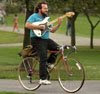
It's been way too cold here lately for me to ride the bicycle and play guitar. It's not good for the wood of the guitar when it's this cold, and not good for my fingers or hands either!
I charged the battery of my 1965 Ford Falcon Ranchero yesterday. Tomorrow I will get a couple gallons of gasoline into it and try to start the engine again. If it doesn't work, then I'll ask for help from people who know more about mechanics than I do.
A few days ago I recorded yet another version of my cover of the Beatles song Help! and posted it to my web site. I've been practicing this song literally thousands of times the past few years, and my playing is getting smoother and smoother. My latest insight about the song came about a week ago and involves the spiraling arpeggio riff played by George Harrison at the end of the intro, each chorus, and the outro.
There are many groups of three in this song, three evenly spaced bass notes between chord changes, three verses, etc. However, that spiraling arpeggio riff consists of sixteen evenly-spaced evenly-stressed notes. It is played by picking four strings of a hand position then moving that same hand position down three more times one fret at a time, in other words, four groups of four notes! Not only that, but that riff is played four times during the song. How much more "fourness" can you get? Well, okay, I see that a riff of four groups of four notes being played four times only references the number four three times! But then, that reinforces the "threeness" in this song.
Showing posts with label George Harrison. Show all posts
Showing posts with label George Harrison. Show all posts
Wednesday, December 9, 2009

Thursday, January 24, 2008
playing HELP! by The Beatles
I've been listening to the Beatles' song Help! a lot lately and playing to it on my guitar.
I adjusted the graphic equalizer of Windows Media Player to emphasize the frequencies of the guitar sounds, and also moved the balance more to the right side where the guitar sound is so I could better hear what parts I play.
Then as if by magic since it had what I had been hoping to find, I found an internet site that is a Tribute to the Beatles film "Help!" This site had free downloads of all twelve studio takes of the title song from April 13, 1965 at Abbey Road. These made it even easier for me to learn the guitar parts played by John Lennon and George Harrison.
Another internet site describes the Help! Recording Sessions. In take 4, George complains that the song is too fast. This was also something John felt according to later interviews. John really liked this song and considered it one of his favorites done with the Beatles. It was a personal cry for Help during what he called his "fat Elvis" period. Apparently the song was written on a dare from a journalist for John to write a song that had words longer than one or two syllables.
I found take 7 best for learning the rhythm of John's guitar part. After take 4, the spiraling arpeggio played by George during the "please, please Help me" part was not played, the time being marked by tapping on the guitar body. There are no vocals in take 7 either. This makes learning the rhythm guitar part much easier. However, take 7 falls apart at the beginning of the third verse.
Take 12 is the version that was used for all the mixdowns of the final song. George Harrison's spiraling arpeggio is more distinct in the studio take than it is in the final mixdown. My fingers get a thrill when they are able to match his notes pluck for pluck in this arpeggio. I can't really explain why I can sit listening to this track over and over again playing along to it on my guitar, except that there is something magical about when what my ears hear matches what my fingers play.
The studio takes are all about a half step down in tuning. Take 7 begins with a guitar being tuned. For playing along, I adjust the graphic equalizer to emphasize the guitar frequencies, move the balance to the right, and keep the headphones slightly off my left ear so I can hear my guitar play along to the song.

For those wishing to learn the song, it is in the key of A. The intro starts with B minor, goes to G (with the D note on 3rd fret of the 2nd string), then to E7, then the spiraling arpeggio played by George Harrison down to A. This is also the chord progression used in the refrain. The verses use an Asus2 as part of the rhythm when playing A, go to C sharp minor, then F sharp minor, then D to G to A.
In the Beatles song, John Lennon's rhythm guitar stops playing while George Harrison plays the arpeggio at the end of the intro and each refrain. When I play the song on my guitar, I play both John's rhythm parts and George Harrison's spiraling arpeggios. I notice that some cover versions of the song, notably by Deep Purple and Oasis, do not include the spiraling arpeggio in their version. To me, this riff is one of the melodic "hooks" of the song. It doesn't sound as good when played at a slower tempo though. Part of its charm is the speed with which the notes flow. What's especially important is the smoothness of the playing.
Deep Purple's version, released in 1968, is in the key of G and is much slower than the original. Noel Gallagher of Oasis also plays Help! much slower. Noel uses the Asus2 exclusively and plays the C sharp minor on the second fret instead of the fourth fret. Noel's voicing of the C sharp minor may be more familiar to some as an A major 7 chord. This voicing sounds "warmer" to me than the way the Beatles played it, and is also easier to play on an acoustic guitar.
Alan W. Pollack analyzes the song Help! as part of his "Notes on..." series on the Beatles songs. All the Beatles shine musically in this song: Paul's bass playing, Ringo's drumming etc. The backup vocals sometimes lead, sometimes follow the lead vocals. There are subtle changes in arrangement for different verse parts. Help! is a good song.
This isn't just my opinion. Granted the Beatles may be overrated as musicians, but the fact is they were the most successful musical group in pop history. As a songwriter myself, I really admire that they helped break ground for musicians to perform their own compositions instead of just playing songs other people wrote as had been the norm in American pop music. The song Help! is number 29 in Rolling Stone's 2004 list of The 500 Greatest Songs.
I hope you can hear me play this song sometime. I plan to record my own cover version of it. Namaste
I adjusted the graphic equalizer of Windows Media Player to emphasize the frequencies of the guitar sounds, and also moved the balance more to the right side where the guitar sound is so I could better hear what parts I play.
Then as if by magic since it had what I had been hoping to find, I found an internet site that is a Tribute to the Beatles film "Help!" This site had free downloads of all twelve studio takes of the title song from April 13, 1965 at Abbey Road. These made it even easier for me to learn the guitar parts played by John Lennon and George Harrison.
Another internet site describes the Help! Recording Sessions. In take 4, George complains that the song is too fast. This was also something John felt according to later interviews. John really liked this song and considered it one of his favorites done with the Beatles. It was a personal cry for Help during what he called his "fat Elvis" period. Apparently the song was written on a dare from a journalist for John to write a song that had words longer than one or two syllables.
I found take 7 best for learning the rhythm of John's guitar part. After take 4, the spiraling arpeggio played by George during the "please, please Help me" part was not played, the time being marked by tapping on the guitar body. There are no vocals in take 7 either. This makes learning the rhythm guitar part much easier. However, take 7 falls apart at the beginning of the third verse.
Take 12 is the version that was used for all the mixdowns of the final song. George Harrison's spiraling arpeggio is more distinct in the studio take than it is in the final mixdown. My fingers get a thrill when they are able to match his notes pluck for pluck in this arpeggio. I can't really explain why I can sit listening to this track over and over again playing along to it on my guitar, except that there is something magical about when what my ears hear matches what my fingers play.
The studio takes are all about a half step down in tuning. Take 7 begins with a guitar being tuned. For playing along, I adjust the graphic equalizer to emphasize the guitar frequencies, move the balance to the right, and keep the headphones slightly off my left ear so I can hear my guitar play along to the song.

For those wishing to learn the song, it is in the key of A. The intro starts with B minor, goes to G (with the D note on 3rd fret of the 2nd string), then to E7, then the spiraling arpeggio played by George Harrison down to A. This is also the chord progression used in the refrain. The verses use an Asus2 as part of the rhythm when playing A, go to C sharp minor, then F sharp minor, then D to G to A.
In the Beatles song, John Lennon's rhythm guitar stops playing while George Harrison plays the arpeggio at the end of the intro and each refrain. When I play the song on my guitar, I play both John's rhythm parts and George Harrison's spiraling arpeggios. I notice that some cover versions of the song, notably by Deep Purple and Oasis, do not include the spiraling arpeggio in their version. To me, this riff is one of the melodic "hooks" of the song. It doesn't sound as good when played at a slower tempo though. Part of its charm is the speed with which the notes flow. What's especially important is the smoothness of the playing.
Deep Purple's version, released in 1968, is in the key of G and is much slower than the original. Noel Gallagher of Oasis also plays Help! much slower. Noel uses the Asus2 exclusively and plays the C sharp minor on the second fret instead of the fourth fret. Noel's voicing of the C sharp minor may be more familiar to some as an A major 7 chord. This voicing sounds "warmer" to me than the way the Beatles played it, and is also easier to play on an acoustic guitar.
Alan W. Pollack analyzes the song Help! as part of his "Notes on..." series on the Beatles songs. All the Beatles shine musically in this song: Paul's bass playing, Ringo's drumming etc. The backup vocals sometimes lead, sometimes follow the lead vocals. There are subtle changes in arrangement for different verse parts. Help! is a good song.
This isn't just my opinion. Granted the Beatles may be overrated as musicians, but the fact is they were the most successful musical group in pop history. As a songwriter myself, I really admire that they helped break ground for musicians to perform their own compositions instead of just playing songs other people wrote as had been the norm in American pop music. The song Help! is number 29 in Rolling Stone's 2004 list of The 500 Greatest Songs.
I hope you can hear me play this song sometime. I plan to record my own cover version of it. Namaste
Subscribe to:
Posts (Atom)